
Moving to Madison AL: Essential Tips for New Residents in 2026
Moving to Madison AL in 2026 places new residents in one of North Alabama’s fastest-growing cities. According to U.S. Census Bureau QuickFacts, Madison’s population exceeded 58,000 residents as of 2023, reflecting steady growth tied to the Huntsville metro’s technology and aerospace sectors. The city stretches along Madison Boulevard, Hughes Road, and County Line Road, linking established neighborhoods with newer developments near Town Madison. Understanding local housing, schools, transportation, and everyday services in advance helps incoming residents settle efficiently and avoid common relocation surprises.
What key facts define moving to Madison AL in 2026?
Madison’s position within the Huntsville metropolitan area shapes many aspects of relocation planning. The city sits roughly 10 miles west of downtown Huntsville along I-565, with Madison Boulevard providing a parallel corridor for employers near Redstone Arsenal. According to the Huntsville/Madison County Chamber, the broader region has added tens of thousands of jobs over recent years, especially in engineering and defense. Neighborhoods along Wall Triana Highway and Browns Ferry Road offer quick access to these employment centers, keeping commuting manageable for many households.
Population growth has also reshaped housing demand. Based on trends reported by Realtor.com through late 2025, entry-level single-family homes in Madison often list between $300,000 and $400,000, while newer construction near Town Madison and along Zierdt Road frequently reaches the $450,000 to $550,000 range. Limited inventory within established subdivisions near Dublin Park and Horizon Elementary encourages buyers to act decisively when well-maintained homes appear on the market.
Living costs extend beyond list prices. According to BestPlaces, Madison’s overall cost-of-living index sits modestly above the national average, largely due to housing. However, property tax rates in Madison County remain relatively low compared with many coastal markets, often near the 0.4% to 0.6% effective range for typical primary residences. Groceries, healthcare, and utilities along Highway 72 and Madison Boulevard track close to or slightly below national benchmarks, helping many households balance higher purchase prices.
How does the cost of living compare when moving to Madison AL?
Housing costs draw most attention from incoming residents evaluating Madison against other regions. According to market summaries on Realtor.com as of Q4 2025, many three-bedroom homes near Rainbow Elementary and Columbia Elementary trade in a band between $320,000 and $430,000, while townhomes closer to Madison City Stadium and Toyota Field can start in the $260,000 to $310,000 range. This pricing typically undercuts large technology hubs yet exceeds many rural communities elsewhere in Alabama.
Everyday expenses remain relatively stable. The BestPlaces index places Madison’s transportation costs slightly below the national baseline, reflecting shorter commutes and competitive gasoline prices along Old Madison Pike and Highway 72. Healthcare access through Madison Hospital on Hughes Road keeps regional medical trips manageable, while multiple Publix and Kroger locations along County Line Road and Browns Ferry Road maintain grocery pricing close to the U.S. average. Entertainment costs at venues like Toyota Field and Dublin Park also stay moderate compared with larger metropolitan stadiums.
Renters experience a different but related calculus. Apartment communities near Balch Road and Mill Creek Greenway often command monthly rents in the approximate range of $1,200 to $1,800 for one- and two-bedroom units, based on listings tracked by Apartments.com in late 2025. Newer mixed-use developments in Town Madison, within walking distance of restaurants like J. Alexander’s and breweries such as Old Black Bear Brewing Company, tend to occupy the upper end of that spectrum due to amenities and proximity to I-565.
Which Madison AL neighborhoods and schools stand out for new residents?
School quality plays a major role in neighborhood selection. Madison City Schools consistently rank among Alabama’s strongest districts. According to GreatSchools, Bob Jones High School holds a rating in the 8/10 to 9/10 range as of 2025, while James Clemens High School posts similar scores. Middle schools like Discovery Middle and Liberty Middle, and elementaries such as Midtown Elementary and Horizon Elementary, help sustain this reputation, encouraging many households to focus searches within the Madison city limits.
On warm evenings near Main Street Café in historic Downtown Madison, the brick storefronts along Main Street catch the low amber light from streetlamps, and the faint aroma of grilled steaks drifts from Old Black Bear Brewing Company. Laughter spills from patios, mixing with the distant bell of a passing train near Church Street. The texture of worn brick, the cool breeze moving down the sidewalk, and the glow from small boutiques all convey a walkable core that feels distinct from newer subdivisions off County Line Road.
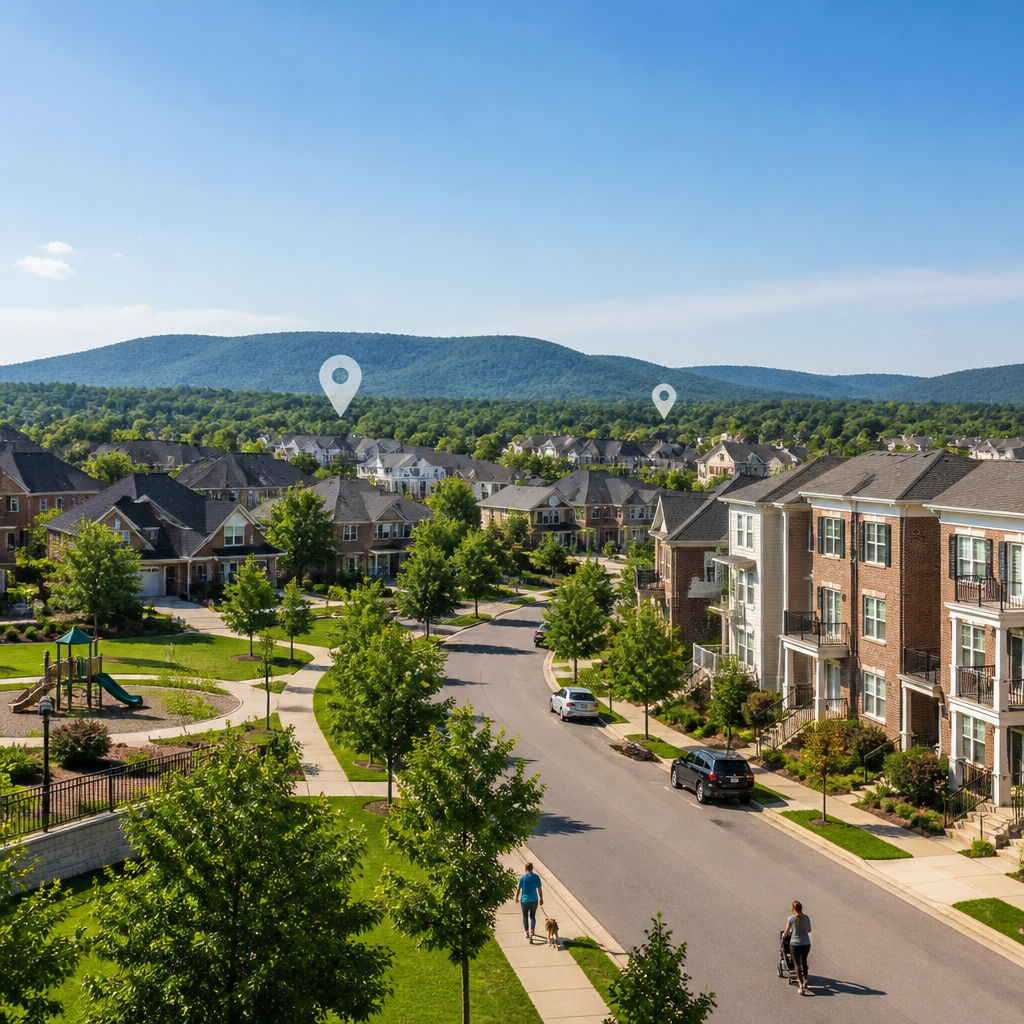
Neighborhoods vary significantly in age and layout. Established areas around Dublin Park and Wall Triana Highway feature mature trees, larger lots, and traditional brick ranch homes, while subdivisions off Burgreen Road and Segers Road showcase newer construction, sidewalks, and community pools. According to Walk Score, Madison’s overall walkability remains car-oriented with a score in the low 20s, but pockets near Downtown Madison and Town Madison offer more pedestrian-friendly routes to restaurants, coffee shops, and small parks.
What is daily life like in Madison AL, from commuting to recreation?
Commuting patterns depend heavily on employment location. According to U.S. Census Bureau data summarized for 2019–2023, Madison workers report an average one-way commute of roughly 21 minutes, shorter than the national figure near 26 minutes. Residents along Zierdt Road and County Line Road often drive directly toward Redstone Arsenal’s gates, while those near Old Madison Pike favor straight routes into Cummings Research Park and the University of Alabama in Huntsville campus on Sparkman Drive.
Weekend mornings at Dublin Park bring a different rhythm. The scent of freshly cut grass blends with the sharp smell of chlorine from the indoor pool, while the echo of basketballs in the gym mixes with whistles from soccer fields outside. Children race along the greenway entrance toward Bradford Creek, and joggers move past the quiet rustle of oaks lining the walking trails. The slightly cool surface of the metal bleachers and the distant roar from Highway 72 create a layered but relaxed atmosphere.
Recreation extends beyond city parks. Mill Creek Greenway and Bradford Creek Greenway offer miles of paved paths for running and cycling along gentle water features, with several trailheads near Mill Road and Browns Ferry Road. Families frequent Palmer Park near Old Monrovia Road for baseball tournaments and playground time. Entertainment at Toyota Field, home of the Rocket City Trash Pandas, adds seasonal minor league baseball, postgame fireworks, and special events that draw visitors from Athens, Owens Cross Roads, and other surrounding communities.
How should new residents prepare for housing and services when moving to Madison AL?
Advance planning for housing searches in Madison can reduce stress considerably. According to market summaries from Realtor.com through early 2026, well-priced homes near Liberty Middle and James Clemens High School often move from listing to pending status in roughly 20 to 35 days. Buyers focusing on specific streets like Mill Road, Balch Road, or Burgreen Road benefit from monitoring listings closely, as desirable cul-de-sac lots and homes backing to greenways draw multiple offers.
Essential services concentrate along key corridors. Hughes Road and Highway 72 host numerous medical offices, grocery stores, and restaurants, while Madison Boulevard and County Line Road provide auto service centers, banks, and additional retail. According to the City of Madison, multiple fire stations and Madison Police Department facilities are distributed across the city, helping maintain response times that support current insurance ratings. Madison Utilities and Huntsville Utilities manage water, sewer, and power connections that new residents typically establish shortly before or after closing.
Planning for schools and registrations also matters. The Madison City Schools district outlines zoning maps that determine assignment to campuses such as Bob Jones High School, James Clemens High School, Discovery Middle, and Liberty Middle, as well as elementary schools like Columbia, Horizon, and Midtown. Enrollment windows, proof-of-residency requirements, and bus routing along major streets including Wall Triana Highway and County Line Road all influence timing for families arriving from other states or Alabama cities.
The population figure above 58,000 residents cited at the start of this guide reflects a city in sustained growth mode rather than a transient boomtown. That same figure from the opening underscores the importance of anticipating competition for homes, school seats, and recreation space as Madison’s appeal broadens through 2026. The ValleyMLS listing platform offers the most detailed real-time view of active and pending properties across Madison’s neighborhoods. Buyers who register listing alerts there and commit to touring promising homes within 24 to 48 hours of market entry before the spring surge in April typically secure stronger positions in negotiations, while those delaying action until late summer often face fewer options and higher prices.
FROM OUR BLOG

Gurley AL Neighborhood Guide: What to Expect in 2026
Gurley AL Neighborhood Guide: What to Expect in 2026 Gurley sits along U.S. Highway 72, about 16 miles east of downtown Huntsville, offering a small-town base within a growing regional economy. According to U.S. Census QuickFacts, the town’s 2020 population fell in the range of 800 to 900 residents,

Owens Cross Roads Residential Properties: The 2026 Buyer’s Guide
Owens Cross Roads Residential Properties: The 2026 Buyer’s Guide Owens Cross Roads residential properties draw increased attention as Huntsville’s growth spills down U.S. Highway 431. According to U.S. Census QuickFacts, the city counted roughly 2,600 residents in 2020, yet new rooftops continue to